
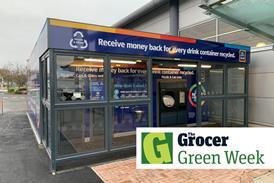





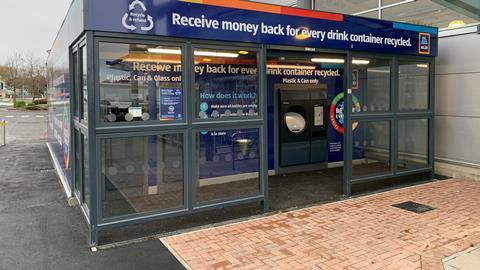
Spades are in the ground with a year to go before the launch of the UK’s deposit return scheme
Video posted on social media this week showed shoppers at an Aldi store in Margate gazing on as builders constructed the foundations for a new reverse vending machine (RVM), one of an estimated 40,000 such installations due to be in place across the UK by the October 2027 go-live date.
Exchange for Change, the industry body charged with overseeing the rollout, announced this week that registration had begun for retailers and producers to sign up to a scheme it hoped had reached the vital “tipping point”. It also announced regional winners of bids to run the logistics of the scheme for rollout: Suez in the north, west and south west of England, Cirqlr in the east and south of England, Bywaters in London, Re.Group in Scotland and R-Gen in Northern Ireland.
But leaked documents revealing the fragility of government commitment to the plans – and recycling bosses launching a renewed appeal for delay – is DRS really on course?
Aldi CEO Giles Hurley tells The Grocer it is working “around the clock to ensure that we’re ready to go”.
“I think we all understand that this legislation brings considerable benefits in terms of a sustainable loop system and we’ll do everything we can to support it,” he adds.
Russell Davies, CEO of Exchange for Change, says the start of construction by players like this sends a powerful signal.
“Images like this are a clear demonstration of the commitment and progress that we’re seeing across industry, and we know the increased visibility of the DRS is going to continue to ramp up in the coming weeks and months,” he says.
There is “enormous commitment” for DRS to go ahead, he says, describing the launch of the registration portal as “another important milestone”.
Yet Exchange for Change admits it does not currently have an accurate database showing exactly where retailers are, despite also launching a monthly Retailer Readiness Survey. “As we open our retailer portal, we’ll be collecting data about the businesses that will be at the frontline in delivery,” says Davies. “This will be followed early next year by the second phase of registration, which will give us a more detailed picture of return points.”
Nick Spearman, CEO at recycling startup Trovr, suggests it is not with supermarkets that the rollout faces its biggest risk.
“On the large-format side, the picture is reasonably encouraging,” he says “Supermarkets know what they are installing, RVM suppliers are engaged and the rollout has a clear shape to it. That part of the network is progressing.
“The concern is what sits beneath it. There are more than 50,000 convenience stores and smaller retailers in scope, and many of them still believe that their only options are a large RVM they have no room for, or bags behind the counter, in the form of manual handling.
“This sounds simple, until you run it in a smaller store. Staff need training on which containers will qualify for the DRS. Space has to be found behind the counter for bags of returns.”
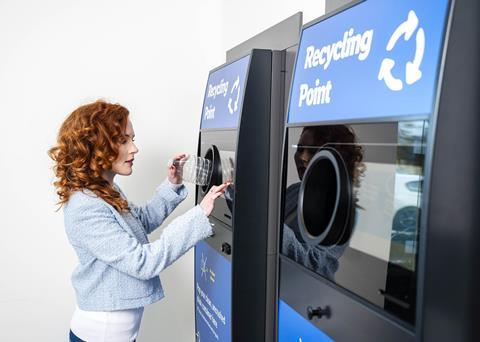
Exchange for Change has previously revealed stores with a retail space under 100 sq m are automatically exempt from operating a return point and do not need to register unless they want to. Urban retailers between 100 sq m and 199 sq m of sales area, and rural retailers under 200 sq m, will have to register, although they will be given details of how to apply for an exemption “in the coming months”.
Sources admit explaining how manual collection works is a mammoth educational task, given the scale of the rollout and the short time left.
‘Point of no return’
Still, confidence is growing the launch will go ahead.
Writing exclusively for The Grocer this week, Andy Bagnall, director general, of the BSDA, says he believes DRS has now reached the point of no return. “The deposit return scheme is happening,” he says. “With one year to go the most important jigsaw pieces are now in place.”
Bagnall points to key barriers to success, such as the recent appointment of Exchange for Change by the Welsh government, having been dealt with, but admits there are still big issues to sort out.
Among them he raises the thorny issue of HM Treasury’s intention, despite major opposition by industry, to apply VAT to the millions of unredeemed deposits expected as the scheme beds in.
Modelling commissioned by PwC puts the cost at an estimated £600m in the first three years of the scheme alone.
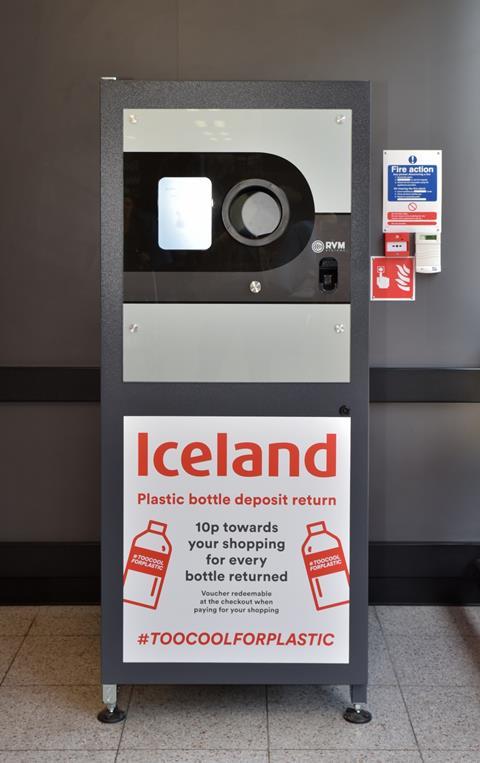
Drinks bosses are also adamant that without further climbdowns from the Welsh government on its plans to include glass in the scheme, the chances of a truly integrated UK-wide launch in 12 months’ time are slim.
“The most important thing about the Welsh government’s appointment of the [DRS administrator] body is that it has helped bring an end to nervousness about whether a joined-up UK wide approach was really possible,” says an industry insider.
“It’s helped remove a lot of that unease about the fundamental political backing for the scheme.”
However, the extent of the government’s commitment to DRS has once again been called into question after a leak to Sky News. It showed a delay to the scheme was one of a potential suite of options offered to the food industry when the government wanted supermarkets to accept plans to bring in price capping, in a response to the cost of living crisis.
The Scottish-style proposals, which caused huge controversy when they were revealed in April, saw government advisers draw up a list of interventions ministers could make to “temporarily ease regulatory burdens” on retailers that were intended to garner their support for price caps.
“One offer could include delaying/pausing the deposit return scheme,” the leaked document says.
“The documents in the leak relate to discussions that retailers had earlier in the year following the start of the Iran crisis,” a retailer source close to events says. “Rachel Reeves was proposing some kind of price capping on a basket of essentials in return for shelving the DRS launch.
“But because nobody wanted to do the price capping, the rest of it wasn’t picked up either – so government took literally no action.
“I would say now that DRS is on track, as far as that is possible for this scheme. I’m not aware of the government looking to do anything about it.”
Drinks giant Suntory warns of a threat posed by plans for new regulations on health, including a shift to a new nutrient profiling model (NPM) which would reclassify tens of thousands of products as unhealthy. The plans could cause “collateral damage” in the vital early days of DRS, it says, by banning products from promotions that could help cushion the price impact on consumers as they get used to paying additional deposits for drinks containers.
“While shoppers will get back the 20p refundable deposit, they pay up front on every in-scope drinks container when they return it, there will still be a visible difference at the shelf and till,” Fraser McIntosh, head of external affairs and sustainability at Suntory Beverage & Food GB&I tells Politics Home.
“That 20p will be particularly noticeable on lower-priced drinks enjoyed on the go. For households already watching every penny, DRS may feel like an upfront price increase.”
“The government risks making delivering DRS even harder.”
Last-minute call to shelve
Nonetheless, other sectors of the recycling chain are still calling for DRS to be shelved.
In a letter to environment secretary Angela Eagle last month, the bosses of seven independent materials recovery facilities (MRFs), collectively processing more than 900,00 tonnes of kerbside-collected recycling a year, said DRS posed a huge threat to the viability of their services.
“The current approach risks establishing a parallel collection system that removes a significant proportion of PET bottles and aluminium beverage cans from established kerbside services,” the letter says.
But most believe the period of greatest peril for DRS has passed.
“The really big stuff for the startup plans is almost complete,” says an insider. “We have agreement on the approach to producer fees, around the 20p deposit level and critically retailer handling fees.
“The building blocks have started to come together and if you look at what’s happened, the ramp-up in activity has been phenomenal.
“There has always been anxiety about the timelines because they are very stretching, but the scheme is on track.
“Certainly around the core scheme for PET and aluminium, I definitely get a sense the whole exercise of bringing together all sectors has been successful, and actually that is pretty bloody unique.”
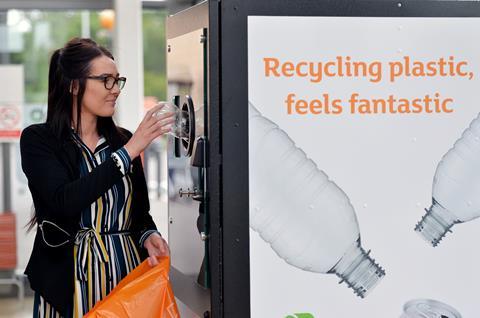
10 minutes with Exchange for Change CEO Russell Davies
It’s 10 months since you joined Exchange for Change. How would you summarise your time so far?
It has been both incredibly busy and incredibly rewarding. We’re a new type of organisation, one that is appointed by government, but led by industry and focused on delivering for everyone.
We’re building one of the most complex environmental infrastructure projects in the history of the UK. Of course, that brings challenges, but we’ve brought together a fantastic team, which is now more than 70-strong, who are driven and passionate about achieving the potential of DRS and are laser-focused on delivery.
We’ve made great progress, hitting numerous major milestones throughout the year such as the confirmation of the 20p deposit level, announcing the return handling and producer fees as well as exemptions and grants that will help support smaller, independent retailers. Crucially, this has all been delivered through extensive consultation and collaboration with industry and this has been, and always will be, a fundamental principle of how we work.
It’s now one year to go until the scheme launches. What would your advice be to retailers and producers to help them prepare?
The first thing I would stress is that we are where we should be in the programme schedule. We have a clear delivery plan which is fully on track and being delivered.
The main advice I would give to industry is, if you haven’t already, start thinking about how DRS will work in different areas of your business. Every business is different, but we’re here to help and we’re focused on providing clear, practical support to support businesses in making the right decisions for them.
We know that 12 months is not a long time, and will also go very quickly, so don’t wait until the launch is imminent to get started, take the time now to get familiar with the deposit return scheme, and plan how you will get ready.
There is a great deal of information available, and plenty more to come as we continue to work through our delivery plan, so go to our website, sign up for our newsletter, ask us questions and speak to your trade associations.
We’ve also recently launched a monthly Retailer Readiness Survey, which will help us to understand in even greater depth how retailers of all sizes are preparing. This valuable insight will allow us to continue refining our approach to meeting industry’s needs for information in the best way. We’ll also be launching similar surveys for different parts of the sector in the coming weeks, so please do take part in the survey and help us to help you.
There has clearly been a lot achieved, but there is still a lot to be confirmed. What are the next major milestones and what do you see as the most significant remaining challenges?
While there is still a lot to do over the next year, we have a clear delivery plan that is fully on track. We’ve just been working through the tender for the logistics and processing partners for the scheme, which will unlock millions of pounds of investment and create new recycling infrastructure across the UK, as well as at around 700 new jobs.
Crucially, this will also allow us to start defining how collections will work in practice for businesses and how processed materials will be used in packaging. We have also just opened the initial registration phase for producers and retailers, and this is very much about engaging with the scheme in as simple a way as possible.
We’ll also be publishing a list of certified reverse vending machines (RVMs) in October, which will continue to be updated as new machines enter the market. These milestones are about giving businesses practical support and tools to help them build DRS into their operations in the most effective way.
Clearly, there will be challenges along the way – and we know that there will be questions in particular about how the scheme will work in Wales. Our appointment as the Deposit Management Organisation in Wales will really help to maximise interoperability and minimise friction for both businesses and consumers, and we’re working at pace and in collaboration with the Welsh government and regulators to define the details of how the scheme will work in practice.
The grocery sector is under pressure, through the cost of living, increased costs, and regulation in other areas. What do you say to those that think now isn’t the time for DRS?
Firstly, I’d say we’re seeing enormous commitment from across industry and a real appetite to get this done. RVMs are being ordered and work is already underway in some stores to prepare for installation.
We also need to remember why the DRS is so important to the UK. It’s estimated that every year more than six billion single-use cans and bottles end up as waste, and some of this also turns up as litter that pollutes our rivers, our beaches, our towns, communities and countryside. Experience from across the globe shows us clearly that a DRS will reduce unnecessary waste of recyclable materials and help protect our environment for generations to come.
At the same time, DRS is an opportunity for industry to help deepen their roles within their communities by being at the heart of something that will deliver tangible benefits locally and nationally. We see from other countries that DRS can also lead to commercial opportunities for local retailers through increased footfall and loyalty.
It’s a privilege to be working to deliver something that will change society for the better, and at Exchange For Change we know that we’ll only achieve this if it works for industry, works for consumers and works for communities. That will always remain our focus as we continue to build towards launch in October 2027 and beyond.
Has there been progress with the Welsh government since the appointment, and are you confident that issues can be sorted out to allow that to go ahead at the same time?
We are in regular and constructive discussion with the Welsh government and regulators, and together we’re making good progress in agreeing how the scheme will work in practice. There is still a lot to do and the timescales are challenging, but I am confident that Wales will be part of the scheme when it goes live in October 2027.
What plans are there for a public awareness campaign and how crucial is that? What will it involve?
Building public awareness and understanding will be absolutely crucial to achieving lasting behaviour change. If people don’t know why they are paying a deposit or how to return containers, then they simply won’t engage with the scheme and it won’t achieve our overarching aim of improving recycling, cutting waste and protecting our environment. That’s why we’re working to make sure that DRS is as simple as possible across the UK.
We’re also working with a wide range of consumer bodies, NGOs and businesses to make sure we’re engaging consumers in the most effective way.
While our communications are largely focused at this stage on helping businesses to prepare for the scheme, consumer engagement will begin in earnest next year and will be extremely wide-ranging.
Importantly, we also recognise the vital role that frontline retail staff will play in this. For many people, retail staff will be at the forefront of how they engage with the scheme and a big part of our work will be in providing the support and materials for retailers to help train and support their staff to make the consumer experience as seamless as possible.








No comments yet