
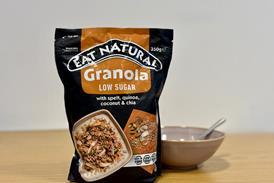
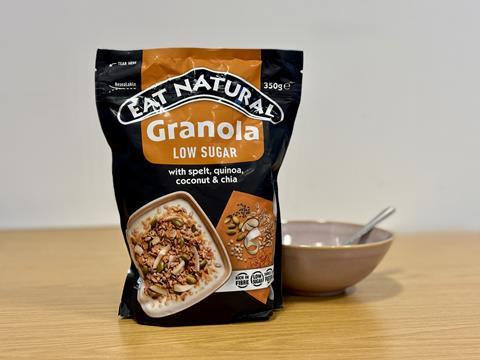
Eat Natural has been blasted by shoppers after reformulating its Low Sugar Granola, with the new recipe likened to “sawdust” and “tasteless small bits of cardboard”.
The new version, which first appeared in Sainsbury’s on 13 October, is 22.2% smaller than its predecessor, with the pack size reduced from 450g to 350g, analysis by The Grocer shows.
It is currently sold at a pre-promotional price of £3.60 in Sainsbury’s, compared with £4.10 for the previous version, last seen in Sainsbury’s on 16 October [Assosia]. This equates to a 12.9% increase in price per kilo.
The new recipe, meanwhile, switches out wholegrain oats for oat flakes, with the sunflower seed content doubling from 11% to 22%.
Almonds, rapeseed oil, chicory root fibre and coconut blossom nectar have been removed, while spelt flakes, puffed quinoa, rye crispie and chia seeds have been introduced. Shredded coconut has been replaced with desiccated coconut chips.
Nutritionally, the NPD contains 26.6% less fibre per 100g than its predecessor. However, it contains 17.5% more protein and 27.3% less sugar per 100g.
Sainsbury’s webstore reviews
The reformation has attracted a swathe of negative reviews on Sainsbury’s website, with shoppers taking to the platform to voice their disappointment.
“The Eat Natural Low Sugar Granola used to be my favourite daily cereal. No longer,” one user said. “What used to be delicious is now like sawdust. I cannot believe Eat Natural’s product development team or Sainsbury’s cereal buyers genuinely believe this is an improvement, so presumably it is now much cheaper to produce. A complete disappointment.”
Another added: “I would give this less than one star if it were possible. This granola was previously the best on the market but they have changed the recipe and it is like chewing tasteless small bits of cardboard. I have thrown mine away after only one bowlful, what a waste of money. They need to go back to their previous award winning recipe. What a disaster for this company.”
Protein Granola reformulation
Eat Natural’s Protein Granola has also been reformulated. Wholegrain oats have been replaced with oat flakes, while pea protein, rapeseed oil and the original mixed seed blend have been removed. Rice syrup, soya crispies, soya flour, sunflower oil and rye crispies have been added.
Shredded coconut has also been replaced with desiccated coconut chips, while roasted chickpeas have been replaced with chickpea crispies.
The new recipe has 7.8% less sugar per 100g, while its fibre and protein content have been boosted by 61% and 13.8% per 100g, respectively.
However, the new recipe has also not resonated well with some shoppers.
“The formulation of this changed when they switched from boxes to bags,” said one user on Waitrose’s webstore. “The quality, texture and ingredients in the new formulation are all now really disappointing. Was once a superior, very tasty product. It’s now the same as any other poor quality protein cereal.”
Another said: “This is nothing like the previous recipe in a box of which I was a regular consumer. Horribly unpleasant, dry, mainly what seems like millet. Yuck.”
Eat Natural was snapped up by the Ferrero Group in 2021, in a move that took the confectionery giant into the healthier snacking category for the first time.
Under Ferrero’s ownership, Eat Natural would continue to produce at its facility in Halstead, with its entire staff – including management – set to be retained, Ferrero said at the time.
Eat Natural and Sainsbury’s had not responded by the time of publication, while Waitrose declined to comment.
Cereal brands turn to reformulation
It comes amid a slew of reformulations across the cereal category. Earlier this year, Dorset Cereals replaced its three-strong Simply muesli range with more expensive and less healthy alternatives. More recently, Kellogg’s removed whole grains of rice from its Rice Krispies and Coco Pops recipes in favour of rice flour.
Dorset said the reformulation followed the “most extensive piece of consumer research the brand has ever undertaken”, while Kellogg’s attributed the changes to drought and extreme weather in Spain in 2022 and 2023, which had significantly reduced the availability of the rice varieties used in Coco Pops and Rice Krispies.




No comments yet