


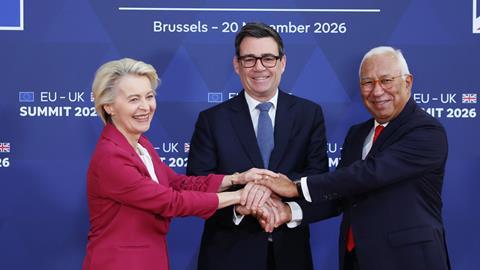
More than two years after Keir Starmer announced his plans for an ‘EU reset’, and over a decade after the UK voted to leave the EU, a deal is now “done” with the bloc that will “cut costs, keep prices down and open up opportunities for young people”, claims the government.
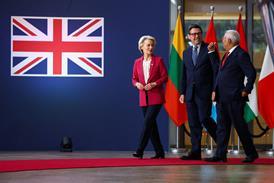
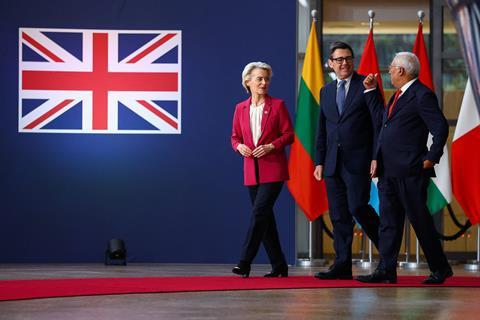
Speaking at a joint press conference in Brussels today alongside European Council president António Costa and European Commission president Ursula von der Leyen, PM Andy Burnham proclaimed the completion of the Framework Participation Agreement, which commentators are already saying could herald even closer ties to come with the EU, represented “a good day for Britain and Europe”.
The deal, described by Burnham as a “win-win” for both sides, consists of a wide-ranging package covering food and drink trade, security and defence, plus carbon markets, youth mobility and other areas of co-operation.
For the grocery industry, however, the standout element is a long-promised sanitary and phytosanitary (SPS) agreement. This will create a common UK-EU SPS area and dramatically reduces the border checks, paperwork and certification requirements that have hampered cross-channel food and drink trade since Brexit.
What’s in the deal?
After “a decade of drift, too much division, low growth in the economy and high prices in the shops”, today’s agreement delivered a “better deal”, Burnham insisted, and one that “directly addresses the biggest challenges of our time”.
Ministers argue the SPS agreement alone will deliver a major boost to the economy, by lowering costs for exporters and improving supply chain efficiency. Government estimates suggest the deal could be worth up to £5.1bn a year to the UK economy by 2040, increasing GDP by up to 0.14% and helping to ease pressure on food prices.
However, as a House of Lords European Affairs Committee report warned last week, this does not include the cost of implementation. Meanwhile, Burnham’s own business secretary Jonathan Reynolds conceded to the BBC this morning that he could not guarantee food would “definitely be cheaper because there’ll be other factors”, pointing to energy prices, global trade and developments in Iran.
Burnham said legislation would be introduced to parliament next week to implement the deal, stressing that major supermarkets and farming groups backed the deal and citing the support of the NFU, Morrisons, Tesco, Asda, Lidl, Co-op and M&S.
An official explainer confirmed the SPS agreement would create a common UK-EU regulatory area covering food, agricultural goods, animals and plants, as well as areas such as organics, food labelling, animal welfare, pesticides and other plant protection products.
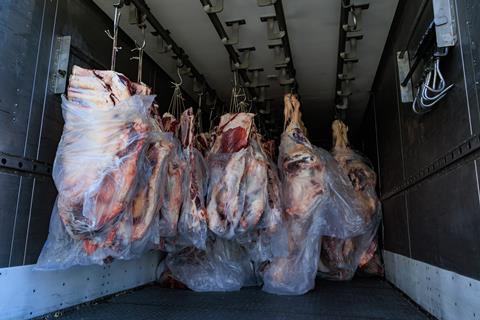
It said the deal would strip away much of the bureaucracy introduced by Brexit, by removing export health certificates – which can cost businesses up to £200 each – and scrapping phytosanitary certificates, which cost around £25 per item.
Further savings of at least £127 would come via the abolition of inspection fees, and the elimination of routine SPS border checks on products such as meat, dairy and fish.
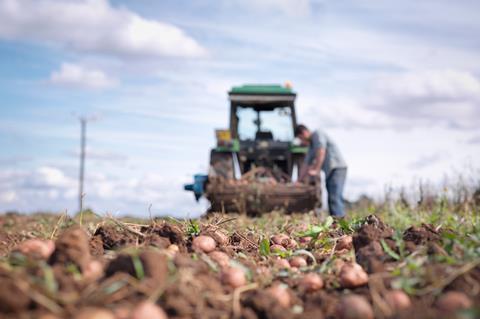
The deal also reopens EU markets to British products including fresh sausages, burgers, seed potatoes and molluscs, and removes certain additional requirements such as certificates of inspection for organic goods.
Meat sector bodies such as AIMS and the British Meat Processors Association have welcomed the reduction in export red tape. BMPA CEO John Powell said the sector had spent the past six years “battling a mountain of paperwork, unnecessary costs and border delays simply to trade with our nearest neighbours”, while AIMS executive director Dr Jason Aldiss warned businesses “could face another 16 months of these costs” before the deal comes into force in March 2028.
Which ‘carve-outs’ have been secured?
The flipside to less friction is the fact the UK’s food and drink sector will also need to follow EU rules under ‘dynamic alignment’ principles. That has caused alarm among some industry bodies over the potential regulatory burden heaped on businesses as well as the increased border bureaucracy facing imports from outside the EU.
Indeed, the Fresh Produce Consortium, which has been vocal about the potential £300m annual cost to importers sourcing from outside the EU under ‘dynamic alignment’, was quick to describe the deal as a “lose-lose” for “UK consumers and our global trading partners”.
CEO Nigel Jenney said its warnings had been “ignored” by government, adding Burnham had already broken his promise to cut food price inflation on fresh produce.
However, a clearer picture around the concessions secured by UK negotiators – under severe pressure from industry – can now be revealed in the wake of the agreement. The most significant of these centres on transition periods and regulatory flexibility.
Growers will be given between nine and 21 months to adapt to new rules covering pesticides and other plant protection products, with the government saying the arrangements will give them “time to adapt and avoid unnecessary waste”. This includes the continued use of certain active substances pending future EU decisions on their approval, a measure the NFU had pushed for in order to avoid “cliff edges” for farm businesses.
But “short transition times will not be enough for industry and growers to respond without urgent clarity on how the new system will work”, according to Dave Bench, CEO of CropLife UK. The industry body warned in January that the aforementioned “cliff edge” could cost growers more than £800m a year.
“The safeguard for three GB-approved active substances is welcome, but businesses need certainty about how it will operate in practice,” he stressed.
”Government must be clear: the UK will be applying decisions it has no vote on. It is vital that every step is taken to ensure that our voice is heard and British growers have the tools they need,” he stressed, adding that the agreement will ultimately mean “British farmers and growers will have less access to innovation than their non-European counterparts.”
The deal also safeguards England’s precision breeding regime for crops until July 2028, when the EU’s own New Genomic Techniques framework will come into effect. Businesses will able to continue marketing precision-bred products under the domestic system until October 2029.
The NFU said it had secured “important mitigations to minimise disruption and safeguard innovation”, including provisions to “safeguard the operation of England’s Precision Breeding Act” and transition periods to help businesses adjust to the new arrangements.
Elsewhere, the government has negotiated transition arrangements for a number of novel foods. Cultivated meat, precision-fermentation products and CBD foods authorised under the current GB regime can remain in production until October 2029, a concession ministers say will protect innovation while the UK moves into the new SPS framework.
This development was described as a “really positive signal for the global cultivated meat sector” by Owen Ensor, co-founder and CEO of Meatly.
“The carve-out shows that the UK wants to be a place where innovation thrives. We have just created Europe’s largest cultivated meat facility here in the UK, and this decision helps to give us conviction to build industrial facilities here in the future, creating jobs and food security here in Great Britain.”
Beyond sector-specific concessions, ministers have also pointed to the UK’s promised “early decision-shaping role” in the development of future EU SPS legislation, arguing it is “essential for ensuring UK interests are reflected”.
The NFU has similarly stressed that the success of the agreement will depend on a “strong UK voice in shaping future EU regulation”, warning that implementation and future influence over the rulebook will ultimately determine whether the promised trading benefits are realised in practice.
Northern Ireland and the Windsor Framework
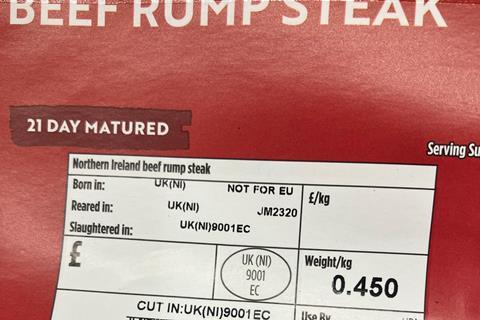
The deal is also being hailed as a breakthrough for businesses trading with Northern Ireland via the Windsor Framework. Under the new arrangements, the vast majority of agrifood goods moving from Great Britain to Northern Ireland will no longer require export health certificates, phytosanitary paperwork or routine SPS checks. The days are of ‘not for EU’ labelling also numbered.
M&S has been a vocal critic of the framework, having long argued the vast volumes of paperwork required to move food across the Irish Sea was restricting product availability and adding unnecessary friction and cost to its supply chains.
“We’ve long championed a UK-EU food trade deal, and today’s announcement is a major step forward,” said M&S Food MD Alex Freudmann.
“Getting our spaghetti bolognese from Lincolnshire onto a shelf in Dublin takes hundreds of extra miles, mountains of paperwork, a vet’s signature and even the Latin name of a cow.”
The deal “will remove this bureaucracy”, he added.
What happens next?
The implementation process will begin almost immediately, with Burnham confirming legislation will be introduced to Parliament next week. However, the SPS agreement itself is not due to take effect until 1 March 2028, with a series of transition periods running beyond that date.
And while the deal has attracted broad support, industry leaders have stressed the hard work is only just beginning.
NFU president Tom Bradshaw said the deal’s success would ultimately depend on “how it is implemented” and the government’s ability to influence future EU rules, while FDF CEO Karen Betts warned bringing EU food law into force across the UK would require manufacturers to make potentially significant changes to “supply chains, products, labelling and ingredients”.
Bradshaw also welcomed the moves to ”minimise disruption and safeguard innovation, while Betts praised the “pragmatic timeframes” agreed with Brussels, though cautioned that “overall the timing remains tight”. Meanwhile, Helen Dickinson, CEO of the BRC, said the priority now must be to “get the detail right” and give businesses “at least 18 months” and clear guidance to adjust to the new trading regime “without unnecessary cost or disruption”.
Others have argued the prize on offer justifies the compromises that come with dynamic alignment.
Rod Addy, director general of the Provision Trade Federation, described closer ties with the EU as “a no-brainer” after the food industry lost “billions of pounds in exports and related costs since the Brexit transition”.
And while acknowledging there would be “trade-offs, unintended consequences for parts of the industry and teething problems as the system beds in”, he argued that “the pros will vastly outweigh the cons” and dismissed concerns over the UK’s diminished influence on EU food law as “largely spurious”, adding that “change cannot come soon enough for food suppliers hit by so much unnecessary cost and paperwork.”
The clock is now very much ticking to make all of this work.



No comments yet