


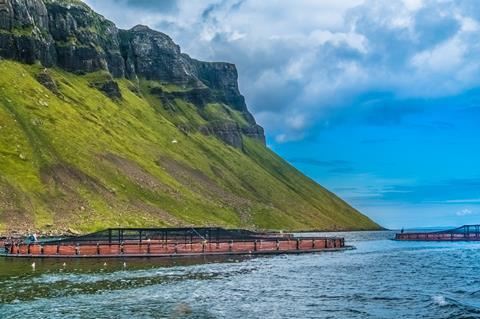
The future of Scotland’s salmon farming sector could be at risk without further action on welfare and sustainability, the Scottish Parliament’s Rural Affairs and Islands Committee has warned.
In a public letter sent to cabinet secretary for Rural Affairs, Land Reform and Islands Mairi Gougeon last week, the committee said it was “disappointed” with “progress in future-proofing the salmon farming industry”.
MSPs on the cross-party wrote to Gougeon after conducting a series of evidence sessions into the future of the sector. It followed a damning report, published in January 2025, which revealed big concerns over environmental, fish mortality and welfare concerns within the sector.
Although the committee recognised “positive steps”, such as the Scottish government’s commitment to introduce baseline standards for the welfare of farmed fish, it remained “particularly concerned” with farmed fish mortality.
Recommendations aimed at addressing farmed fish mortality through strengthened regulation and improved transparency had not been accepted by the Scottish government, MSPs on the committee warned.
“The committee expects to see sites with persistently high mortality to be regulated effectively and does not agree with the analysis of the Scottish government that this does not represent a systemic issue,” committee convener MSP Finlay Carson said.
In a report released this March, the Marine Directorate claimed persistent high levels of fish deaths in marine salmon farms was “not a widespread issue”. The industry was “already taking prompt steps to reduce mortality to the lowest possible levels”, it said.
The committee also raised concerns with the lack of progress made in protecting wild salmon from risks posed from farmed salmon. It said a wide-ranging inquiry into wild salmon could be of significant value to understanding the reason for declining stock numbers.
Carson added: “The committee stands by its report’s recommendations and expects the Scottish government to set out a work plan in the early part of the next parliament to deliver them to ensure the industry is placed on a sustainable footing and able to provide employment and prosperity for Scotland’s rural communities for future generations.
“Failure to act decisively and with urgency would allow commentary around the industry’s future to persist.”
Read more:
-
‘No new regulation needed on salmon mortalities’ report finds
-
Salmon Scotland says India is ‘the next major opportunity’
-
Demand for Scottish salmon surges in China
-
Scotland’s largest ever salmon farm secures permission
Animal Equality UK director Abigail Penny said the letter was a “damning indictment”.
“Clearly, this industry cannot meet even the most basic of standards. It’s no wonder that public trust is evaporating, with more and more people now calling for a halt to the industry’s expansion,” Penny said. “These giant multinational companies far too often act as though the rules don’t apply to them, but as consumers we have the power to hold this industry accountable.”
She added: “Every time we leave farmed salmon on the shelf, we send a clear message that we refuse to fund large-scale animal suffering.”
WildFish said the committee delivered a clear and sobering assessment of a system that was failing both wild fish and the marine environment.
“When a parliamentary committee acknowledges ongoing environmental harm, progress stalled in the courts and a lack of effective controls, the logical conclusion is hard to avoid: our planning authorities should not be allowing further expansion of salmon farming,” said WildFish Scotland director Nick Underdown.
He added: “While the committee stops short of explicitly calling for a moratorium, it has come very close to doing so in substance.”
‘Better, modern regulation’
Scottish salmon is the UK’s largest food export, recording international sales of £838m in 2025. Salmon Scotland called the Scottish salmon sector one of the “most highly regulated food sectors in the world”.
The sector has, however, been dogged by animal welfare concerns and its effect on the marine environment. In a recent high-profile case, Shetland Island Council gave the ‘go-ahead’ to Scottish Sea Farms’ £8m Fish Holm redevelopment at Yell Sound on 11 February despite significant opposition.
“The Scottish government’s own analysis is clear that persistently elevated mortality is ‘not a systemic problem for Scottish marine salmon farms’,” a spokesperson said, adding it supported calls for an inquiry into wild salmon.
Tavish Scott, chief executive of Salmon Scotland, recently wrote to the Rural Affairs and Islands Committee backing Fisheries Management Scotland’s call for a further inquiry session into wild salmon management, the environmental pressures facing the species, and the introduction of rod licences.
The spokesperson added: “The focus now should be on better, modern regulation that supports continuous improvement and sustainable growth through a clearer, more streamlined consenting and planning system.”







No comments yet