





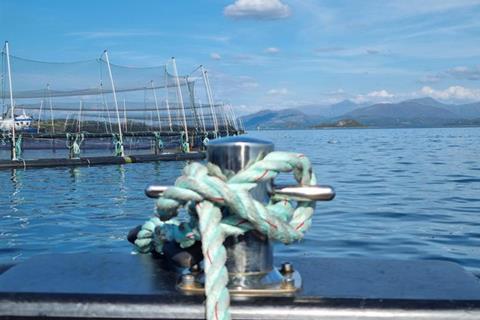
Atlantic salmon production continued to increase in 2025, according to the Scottish government’s latest Scottish Fish Farm Production Survey.
The data showed Scotland’s salmon farming sector produced 3% more fish last year, with the total reaching 197,836 tonnes.
While the rise did not equal the 27% surge experienced from 2023 to 2024, the total figure was highest recorded since the sector produced 205,393 tonnes of fish in 2022.
The report also expects salmon production to grow again in 2026, predicting production to reach 199,200 tonnes.
Salmon Scotland chief executive Tavish Scott said the numbers were “another vote of confidence in Scottish salmon”, adding farmers were responding to “strong demand at home and growing interest in markets around the world”.
As reported by The Grocer in February, international sales of Scottish salmon reached £828m in 2025 and much of the increase was put down to expanding demand in the US and China – up 44% and 55% in volume year on year respectively.
The sector also launched a “landmark” trade mission to India on 5 October, following the removal of the 33% tariff on Scottish salmon earlier this year, and has predicted the market could be worth up to £130m over the next decade.
The salmon industry body chief said the rise in the number of people directly employed in seawater salmon production, which rose 4% to 1,410 in 2025, showed “the importance of salmon farming to Scotland’s rural and coastal communities”, Scott added. “These are high-quality, well-paid jobs which help sustain local economies and enable communities to thrive.
“Our producers are continuing to invest for the future, helping ensure Scotland can meet growing demand at home and overseas while supporting the communities where salmon farming matters most.”
Despite this, mean productivity decreased from 141 to 140 tonnes per person.
Despite improved production and employment figures, environmental campaigners remain concerned with the number of unplanned fish deaths – something salmon farmers Loch Duart and Bakkafrost both highlighted issues with this year.
NGO Green Britain Foundation lamented the loss of 15 million salmon that “never made it to harvest” in what it dubbed “Scotland’s underwater factory farms”.
Of the near 49 million put to sea in 2023, 68.8% made it to harvest – around 34 million. While the survival rate bettered the figure recorded in 2022 (61.8%), it is lower than the average rate (75.9%) seen between 2016 and 2020.
“That’s industrialised death and it’s only part of the picture,” said Green Britain Foundation campaign director Rupert Evelyn. “It doesn’t count fish lost in hatcheries or the cleaner fish that die in the pens.”
Evelyn further pointed to regional variation in survival rates, such as in the Western Isles where he said, “close to half never made it”, with a 55.4% survival rate.
The highest survival rate was recorded in Shetland, which saw an 80.4% rate, followed by the remaining regions including the south west (75.8%) Orkney (70.2%) and the north west (67.8%).
“Every one of those fish was fed on wild fish taken from the sea and not one of them ended up on a plate,” Evelyn added. “It’s a hugely wasteful way to produce food.”







No comments yet