




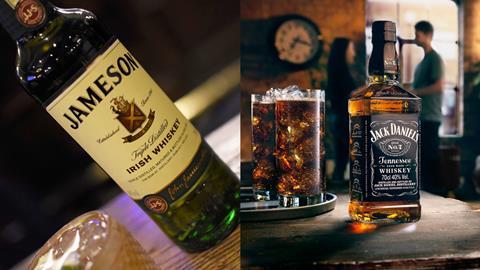

Jack Daniel’s and Jameson are two of the most iconic booze brands in the world. Soon they could share a common owner.
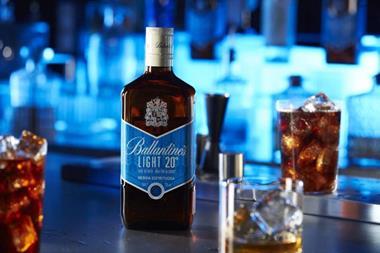
On Friday, news broke that Pernod Ricard, the French owner of a slew of household booze brands including Jameson, Absolut, Malibu and Ballantine’s, was in talks with Jack Daniel’s owner Brown-Forman over a “merger of equals” to create a transatlantic spirits powerhouse with annual revenues of nearly €15bn (£13bn).
A coming together of these two giants would arguably be the biggest shake-up in booze since Pernod Ricard became the second largest global wine and spirits player when it bought Allied Domecq in 2005 (with honourable mention to Suntory’s acquisition of Beam, back in 2014).
So, why exactly are the two groups in talks, and how would a merger benefit both parties?
Troubled times
The post-pandemic years have not been kind to global spirits majors. Shoppers surged to stock up on posh spirits as the world locked down, but sky-high inflation and health concerns have seen that fall away in the past three years. Punitive tariffs and global geopolitical turmoil have also played a significant part in the painful sales slowdown.
Neither Pernod Ricard nor Brown-Forman have been immune to these challenges. Organic sales at Pernod slid by 5.9% to €5.3bn in the six months to 31 December 2025, driven by large declines in the US and China. Revenues at Brown-Forman dipped 5% to $4bn in 2025, with US whiskey hit by sharp declining demand. Investors have deserted the duo in their droves, with Pernod and Brown-Forman shares down by a fifth and a quarter respectively in the past year.
The benefits of a merger – greater scale, product synergies and cost savings – could certainly help mitigate the challenging conditions dogging the two businesses. “The industry is going through a lull,” notes Jefferies analyst Ed Mundy, pointing out savings could be reinvested or put towards “increased feet on the street or upweighted A&P spend” to drive sales growth.
Merger of equals
The minimal category overlap between Pernod and Brown-Forman’s portfolios means those synergies could well be meaningful. Brown-Forman overindexes in US whiskey and tequila, which made up almost 85% of its sales in 2024 [IWSR/Bernstein]. By contrast, Pernod Ricard’s portfolio is more balanced, with 40% of net sales coming from scotch and Irish whiskey, and a further 13% and 11% from vodka and cognac respectively.
“In a merger of equals, Brown‑Forman becomes less dependent on American whiskey, which today dominates its earnings base and exposes the company to category‑specific risks,” says Barclays analyst Laurence Whyatt. “Pernod Ricard, meanwhile, would gain authentic scale in US whiskey, a category where it has been notably light.”
The acquisition would also help shore up Pernod’s weak spot in tequila, Whyatt says, complementing its own brands with Brown‑Forman’s “larger offerings at premium and super‑premium price points”. The resulting portfolio would be better balanced “across categories, countries and consumption occasions,” he argues.
Perhaps more significantly, the two companies’ geographic footprints are also highly complementary. Brown-Forman generates nearly half of its sales from the US, compared with just 19% for Pernod Ricard in FY25 [IWSR/Bernstein]. But Pernod Ricard sales are skewed towards emerging markets (circa 45%), where Brown-Forman is very underweight. “A combination would likely generate material synergies with minimal competition issues,” says Bernstein’s Trevor Stirling.
Merging with Brown-Forman would also bump Pernod Ricard to the number two player in the US, a market where the French group has struggled for some time. Additional scale remains “a critical determinant of bargaining power with the major US distributors,” Whyatt notes, adding both Brown-Forman and Pernod “have historically lacked the distribution clout of Diageo” across the pond.
Pernod Ricard’s routes to market in Europe, India and China would provide a significant growth runway for Brown-Forman brands such as Jack Daniel’s, Woodford Reserve and El Jimador. Together, Brown-Forman and Pernod would also have a market share slightly greater than Diageo in Europe, according to Barclays.
What’s not to like?
The deal looks good on paper, then. But there are still hurdles to overcome.
For one, Jameson and Jack Daniel’s – two of the highest volume brands in both companies’ portfolios – are competing brands. The duo have distinct origin stories but both play in the high-tempo dark spirits consumption occasion. Can they co-exist? Jefferies’ Mundy believes so. “A Jack/Jameson portfolio would be a very powerful combination (>$10bn retail sales), which could provide a halo effect for the broader portfolio,” he says.
However, there’s no guarantee the same is true of the controlling families of the two businesses. The Brown family retains control over key business decisions, while the Ricard family holds just over a fifth of voting rights in the Paris-headquarted company. There would be “lots of vested interests to manage”, Whyatt says, adding that “a merger still has complications, especially when families are involved”.
Both companies have positioned the deal as the coming together of equals. But Pernod Ricard is the bigger player and its shareholders would have 63% ownership of the combined entity based on relative market caps before the story broke, according to Bernstein estimates. Questions remain on who would lead the combined business, what its corporate structure would look like, and where it would be listed and headquartered.
Opinions vary on how easily these hurdles can be overcome. “In our view, the biggest issue is likely to be cultural fit, both at a corporate level and between the controlling shareholders,” says Stirling.
Brown‑Forman has rebuffed takeover approaches in the past, Whyatt notes, most notably from Constellation Brands in 2017. That said, the company’s statement on talks with Pernod Ricard was “more open and constructive” than in previous situations, he adds.
Mundy believes there is a reasonable cultural fit between the two families. He points to Pernod Ricard CEO Alexandre Ricard’s US education and “international mindset”, adding that “both families take a very long-term view (which is key for the spirits industry), both value provenance and place a high premium on brand building”.
Top-line challenge
The greatest challenge to be overcome though, is that of sliding sales. Pernod Ricard and Brown-Forman’s major brands are nearly all in decline, and the overarching macro environment for spirits remains soft.
“The deal per se would not fix the biggest challenge facing the two companies: top-line growth,” says Stirling, who cautions that bringing together two complex organisations is also likely to result in “a lot of disruption”.
The extent to which both parties believe that short-term shock will be outweighed by future upsides will become clear in the weeks to come.








No comments yet