



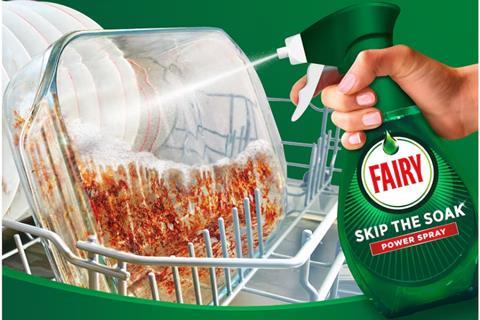
Fairy Skip The Soak was the most successful new product innovation in 2025, according to a new study from Worldpanel by Numerator.
The three-in-one cleaning spray saw off heavyweight brands in ice cream, crisps, cola, deodorant and toothpaste to claim top spot in Worldpanel’s Innovation Advantage report, which assessed 647 eligible products purchased by 30,000 shoppers across Great Britain last year.
Skip The Soak was launched by Procter & Gamble in January 2025, with the supplier billing the innovation as a “concentrated formula designed to provide the results of an overnight soak in just minutes”.
In the year ended 28 December 2025, the NPD added £11.5m in incremental value to the dishwash category, Worldpanel said.
Magnum Utopia, Walkers Tomato Ketchup & Worcester Sauce, Ariel The Big One and Sure Whole Body make up the remainder of the top five most successful innovations in the report. It used category incrementality – the net value an innovation adds to its competitive set – to determine the success of NPD.
“Innovation is still the most powerful lever available to fmcg brands, but the industry has been measuring it against the wrong benchmarks for too long,” said Mark Smithson, analytical solutions director at Worldpanel. “Sales volume tells you how much activity a launch generated. Category incrementality tells you whether that activity created something genuinely new.”
What determines NPD success?
In a bid to discover the secret formula behind successful innovation, Worldpanel’s Innovation Advantage report also assessed 400 of the best-performing pieces of fmcg NPD over the past three years.
It found that most incremental launches commanded a price premium of 50%-80% above category norms, delivered through pack sizes 15%-25% smaller than standard. This was successful as it kept “entry accessible without diluting the premium signal”, Worldpanel said.
Meanwhile, successful NPD was typically promoted 40%-70% more frequently than the competitive set average, but discount depth was below category norms. Shallow discounts allowed shoppers to discover new products, without developing dependency on them to drive purchase, Worldpanel noted.
“Across the top performers, the formula is clear: a meaningful premium, accessible trial, promotional visibility without deep discounting, and a penetration-first mindset,” Smithson said.
Other findings in the report include the discovery that nearly half of all new product launches (48%) actually reduce overall category spending rather than growing it, and there is no relationship between launch size and category incrementality.
Big launches can be “highly additive or actively disruptive”, and scale does not determine which, according to Worldpanel.
Meanwhile, manufacturers holding over 30% share of their competitive set see almost 60% of launch sales drawn from their own portfolio, suggesting cannibalisation for market leaders is inevitable.
“For the largest brands, even disciplined execution… has to contend with the reality that a significant proportion of launch sales will come from their own portfolio,” said Smithson. “The brands that navigate this best are the ones innovating into new needs, not competing harder for the same moments.”




No comments yet